
Garage Door Maintenance & Tune-Ups in Nanaimo
A technician checks 34 points on your door and gives you options in writing before any work.
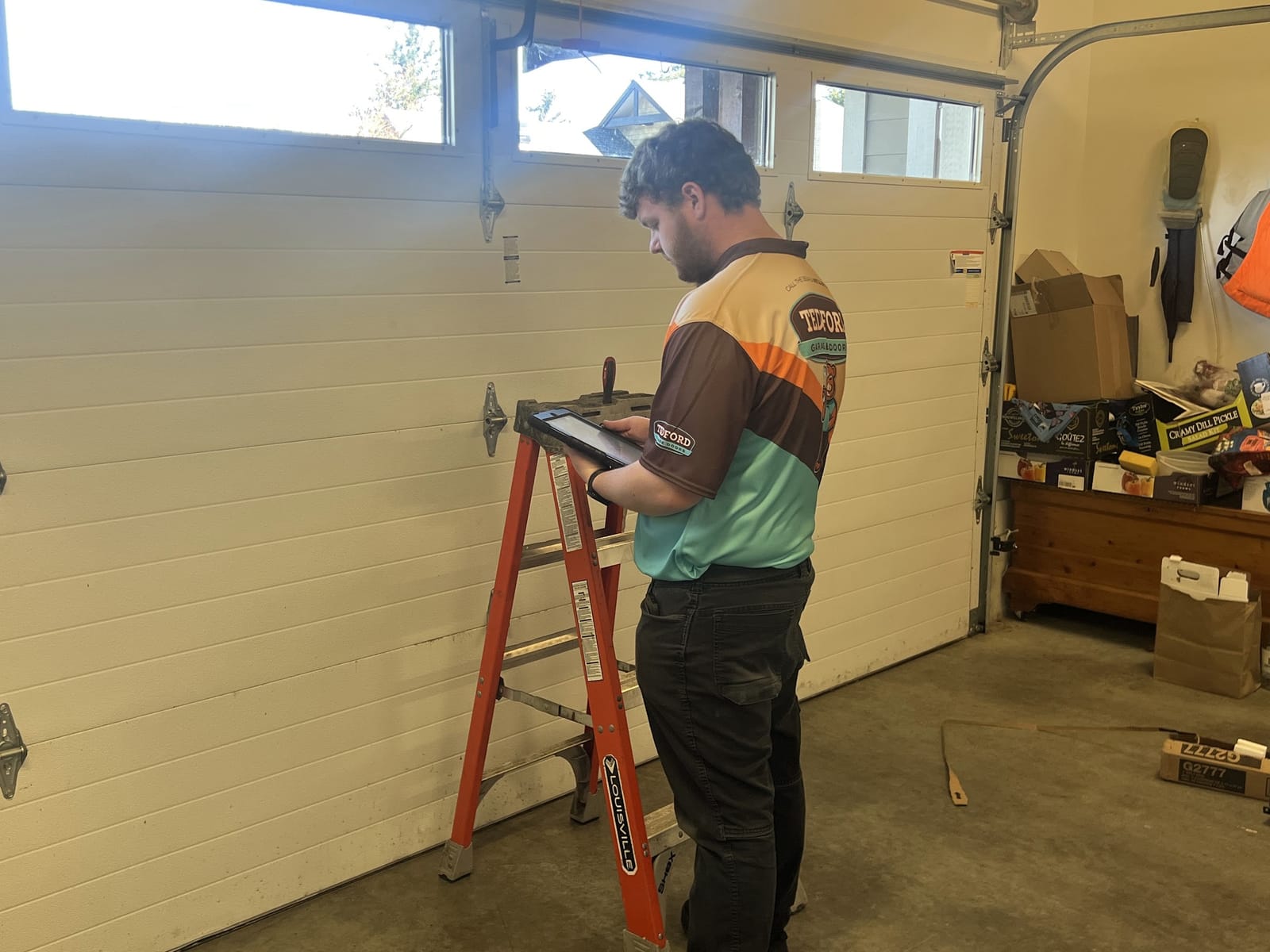
The garage door is the heaviest moving object in most Nanaimo homes, and it works hard in every season. Salt air off the Strait of Georgia, months of winter rain and daily use all take a toll: springs lose tension, rollers wear flat and cables fray where nobody looks. A maintenance visit catches that wear early, whether you're in Departure Bay, Harewood or a newer subdivision off Hammond Bay Road, so a small fix now can head off a failed door later.
The visit is done by the same licensed, insured technicians who handle our repair calls. They weigh the door on a scale, run a 3-point balance test and a safety reverse test, and work through Tedford's 34-point safety check, photographing what they find. You then get their notes, recommendations and pricing options in writing, so you know what's in good shape, what's wearing and what can safely wait before you approve anything. Tedford has been servicing doors on Vancouver Island since 1984, so we know how these systems age here.
We check
- Door weight, on a scale
- 3-point balance test
- Safety reverse & safety eyes
- Springs, cables & drums
- Bearings & torsion tube
- Rollers, hinges & brackets
- Opener drive, remotes & battery backup
- Panels, paint & bottom seal
How it works
Step 1: Book a visit
Call or book online for a weekday time that suits you, anywhere in Nanaimo or the surrounding communities. Office hours are Monday – Friday, 8:00 am – 4:30 pm.
Step 2: 34-point check
Your technician weighs the door, runs the balance and safety reverse tests, then works through the opener, springs, cables and hardware one checkpoint at a time, photographing what matters.
Step 3: Options in writing
Your technician walks you through what they found and gives you pricing and options in writing. Nothing is done until you approve it.
The 34-point safety check
This is the 34-point checklist Tedford technicians use to assess a door system and find what may be wrong before giving you repair options. Each checkpoint is recorded and the parts that matter are photographed, so you see exactly what was checked and what was found before you approve any work.
Opener1–11
- 1Cycle count recorded
- 2Gears and sprocket checked for wear and proper lubrication
- 3Safety eyes tested for proper operation
- 4Trolley and carriage checked for stripped or worn parts
- 5Belt, chain or screw drive checked for lubrication and abnormal wear
- 6Electronics and wiring checked for proper operation
- 7Remotes tested for range and operation
- 8Keypad tested
- 9Opener light bulbs working, and a type that won't interfere with the opener
- 10Battery backup tested and battery age noted (batteries last 5 years at most)
- 11Opener model and manufacture date photographed
Door appearance12–15
- 12Paint checked for chipping, fading and oxidation
- 13Bottom rubber checked for drying, cracks and a proper seal
- 14Stop molding and trim checked for a proper seal and warping
- 15Panels checked for stress cracks, dents and sagging
Safety & structure16–22
- 163-point balance test (pass/fail)
- 17Safety reverse test (pass/fail)
- 18Opener plugged into a surge protector
- 19Door insulation value noted
- 20Operator reinforcement bracket (ORB) installed
- 21Strut fitted and mounted in the correct location
- 22Spring pad secure and free of cracks and rot
Torsion system23–29
- 23Door weighed on a scale with the door down
- 24Scale reading photographed
- 25Springs checked for rust, slipping and cracked cones
- 26End and centre bearings checked for looseness and wear
- 27Cable drums checked for wear
- 28Lift cables checked for fraying, kinks and stretching
- 29Torsion tube checked for level and bends
Door hardware30–34
- 30Hinges checked for cracks and excessive wear
- 31Bottom brackets checked for wear and cable security
- 32Top brackets checked for bends or breaks
- 33Rollers checked for worn plastic, metal or nylon
- 34All fasteners checked for proper tightness
What you get afterwards
- Photos of the garage from inside and outside, with the door up and down
- The technician's notes on anything worn, out of balance or unsafe
- A written evaluation with recommendations
- An inspection sticker on the door and the opener
How pricing works
| Repair | Price |
|---|---|
| Trip fee inside our service area | $0 |
| Tune-up & lubrication | Quoted on site |
| Roller replacement | Quoted on site |
| Weather seal replacement | Quoted on site |
A technician inspects your door system, then gives you pricing and options in writing to approve before any repair is done. Pricing depends on your actual door system, so we don't publish typical prices. GST is added to all prices.
Maintenance reviews
“I am extremely satisfied with Tedford, they were both n time, efficient, polite and cleaned up after them selves. I thought my garage door was running smooth prior to being serviced by Damian , I was wrong. It’s running incredible now, recommend Tedford and Damian. Thanks for the great job.”
Ryan R. via Google “Had JD come and service our garage door that had not had one in a long time, he was very thorough and explained everything. Gave us lots of options of how we could proceed. Effectively did the service.”
Barry H. via Google
What does Tedford's 34-point garage door safety check include?
Tedford's 34-point safety check covers the opener, the door's appearance and seals, its safety and structure, the torsion spring system and the door hardware, and technicians use it to find what may be wrong before giving you repair options.
The technician weighs the door on a scale and runs two pass/fail tests: a 3-point balance test and a safety reverse test. Springs are checked for rust, slipping and cracked cones, along with the bearings, cable drums, lift cables and torsion tube. On the opener they check the gears, drive, trolley, safety eyes, wiring, remotes, keypad, light bulbs and battery backup, and record the cycle count. Panels, paint, the bottom rubber, trim, hinges, rollers, brackets and fasteners are all checked too, as are the strut, spring pad and opener reinforcement bracket.
If the check turns up a part that needs repairing or replacing, Tedford gives you pricing and options in writing, and the work is only done once you approve it.
How often does a garage door need maintenance or a professional inspection?
Most garage doors on Vancouver Island should get a professional inspection once a year, and twice a year if the door is used heavily or sits near salt water. A door that serves as the main entry to the house, opening several times a day, wears springs and rollers faster, and waterfront homes from Departure Bay to Nanoose Bay see hardware corrode sooner. Between visits, do a quick monthly check: watch the door travel, listen for new noises and test the auto-reverse. Booking a Tedford maintenance visit in early fall is a good habit, because a stiff, unbalanced door is at its worst on cold, wet winter mornings. If the door starts making a new noise, lifts with a jerk or the opener slows down, book a visit right away rather than waiting for the next one.
Is a garage door inspection worth it if my door seems fine?
A garage door inspection does the most good when the door seems fine, because springs, cables and rollers wear gradually and often fail without obvious warning. A torsion spring can carry fatigue for months before it snaps, and frayed lift cables are easy to miss along the edge of the door. Catching that wear early turns a likely emergency into a planned repair on your schedule. The inspection also confirms that the opener's auto-reverse and photo-eye sensors still protect children, pets and vehicles. A Tedford technician works through all 34 points and tells you what can safely wait and what can't.
What happens if the garage door inspection finds a problem?
If Tedford's technician finds a worn or unsafe part, they show you the problem and give you pricing and options in writing before any repair work begins. Nothing is replaced without your approval, and there's no obligation to go ahead. If you do, common parts are carried on the truck, so many repairs can be finished during the same visit, and same-day service is available, subject to technician availability. If you'd rather wait, you'll know which items to watch and how urgent each one is. While the current offers run, a residential repair qualifies for $25 off when you mention it.
How do I test my garage door's auto-reverse safety feature?
To test a garage door's auto-reverse, close it with the opener onto a 2x4 laid flat under the centre; the door should reverse when it touches the board. Next, start closing the door and pass an object such as a broom handle through the photo-eye beam near the floor; the door should stop and go back up. Opener manufacturers recommend doing both tests monthly. If the door presses down on the board or ignores the beam, stop using the opener and keep everyone clear until it's fixed, because the safety system isn't working. Every Tedford 34-point inspection includes a pass/fail safety reverse test and a check of the safety eyes.
How do I check whether my garage door is balanced?
To check garage door balance, close the door, pull the opener's release cord and lift the door by hand to waist height; a balanced door stays put. Only do this if the springs look intact, and never pull the release cord on an open door with a broken spring. If the door drifts down or creeps up, the springs no longer match its weight. An unbalanced door makes the opener work harder, wears it out faster and puts extra load on cables and rollers. Don't try to adjust the springs yourself, because torsion springs are wound under heavy tension. Reconnect the opener and book Tedford: on the inspection the technician weighs the door on a scale and runs a 3-point balance test, so the springs can be matched to the door's actual weight.
What lubricant should I use on my garage door, and can I use WD-40?
Use a silicone or lithium-based garage door lubricant; regular WD-40 is mainly a cleaner and water displacer, not a long-lasting lubricant for door hardware. Spray the hinges, the bearings of steel rollers, the springs and the bearing plates at each end of the torsion bar, then wipe off any excess. Keep the inside of the tracks clean and dry, since grease there collects grit and makes rollers skid instead of roll, and don't oil a belt drive. Every three to six months suits most homes, more often near the ocean. Tedford checks the rollers, hinges and springs on every 34-point inspection.
What garage door maintenance can I do myself, and what should I leave to a technician?
Homeowners can safely clean, lubricate, visually check and test a garage door, but springs, lift cables, bottom brackets and track realignment should be left to a technician.
Once a month, watch the door run, listen for scraping or grinding, test the auto-reverse and check the bottom seal for gaps. A few times a year, rinse salt and grime off the panels, wipe the tracks and lubricate the moving hardware. The parts on the technician list all hold or connect to the spring tension that lifts a door that can weigh 60 kg or more, and releasing that tension unexpectedly causes serious injuries. If something on that list looks worn, book Tedford rather than adjusting it yourself.
Why is my garage door so noisy, and how can I make it quieter?
A noisy garage door is usually caused by worn steel rollers, dry hinges, loose hardware, an unbalanced door or an older chain-drive opener. Grinding or squealing often means roller bearings are dry or worn; nylon rollers with sealed bearings run far more quietly than bare steel. Rattling points to loose bolts on hinges and track brackets, which you can snug up, but never loosen or tighten the bottom brackets, which hold cable tension. A bang when the door closes, or a door that suddenly feels heavy, suggests a spring problem. Tedford's inspection covers rollers, hinges, balance and the opener, and the technician can quote new rollers or a quieter belt-drive opener.
Why does rainwater come in under my garage door?
Rainwater usually gets under a garage door through a worn or flattened bottom seal, an uneven concrete slab, or a driveway that slopes toward the door. The rubber bottom seal hardens and cracks with age, and through a long, wet Island winter even a small gap lets in water, leaves and mice. If you can see daylight under the closed door, the seal isn't doing its job. Replacing the seal, and sometimes the retainer that holds it, fixes most leaks, and where the slab has settled unevenly a threshold strip on the floor can help. Weather seals are one of the repairs Tedford handles, and they're checked on every 34-point inspection.
Why is my garage door frozen to the ground, and how do I free it?
A garage door freezes to the ground when water pools under the bottom seal and turns to ice during a cold snap, bonding the rubber to the concrete. Don't keep pressing the opener: straining against the ice can strip the drive gear, tear the seal or trip the force setting. Instead, gently free the seal with a plastic scraper or a hair dryer, and avoid boiling water, which refreezes and can crack concrete. Once it's free, clear slush from the threshold and wipe the seal dry; a light coat of silicone spray on the rubber helps prevent sticking. If the door strained against the ice and now runs unevenly, have Tedford check the opener and cables.
How should I care for a garage door near the ocean?
A garage door near the ocean should be rinsed with fresh water a few times a year, because salt spray speeds up rust on steel panels, springs and hardware. Wash the panels with mild soap and water, and rinse the tracks, hinges and bottom brackets where salt collects. Touch up paint chips quickly so bare steel isn't left exposed, and watch the bottom section, which takes the most spray and rain. Springs and cables corrode faster on waterfront lots, so twice-yearly inspections are worth it from Lantzville to Qualicum Beach. Tedford has serviced Vancouver Island doors since 1984 and checks for rust and corroded hardware on every 34-point inspection.
Should I get a garage door inspection when I buy a house?
Booking a separate garage door inspection is worthwhile when buying a house, since a general home inspection usually checks that the door works, not how worn its springs are. Springs wear out by the number of cycles, not the calendar, so a door that has never been serviced can be close to failing without showing it. Tedford's 34-point safety check gives you a point-by-point picture of the door, springs, opener and seals, with photos and the door's measured weight, and any repair is quoted in writing before work starts. It's also a good moment to clear the opener's memory so the previous owner's remotes and keypad codes stop working.
Also in Nanaimo: